Early in the SARS-CoV-2 pandemic, the WHO said things like “Most people will experience mild symptoms,” meaning they will not require hospitalization. Most people, when thinking about a “mild” illness, probably imagine something annoying, but not really limiting. A mild headache is annoying, but one can still work or go out. So, many people were, and are, surprised when Covid puts them in bed for a week with a 40°C fever, barely able to eat. That wouldn’t feel “mild” to anyone. But as long as a person doesn’t require hospitalization, that is mild according to the WHO. A similar minimization is going on with the classification of myalgic encephalomyelitis.
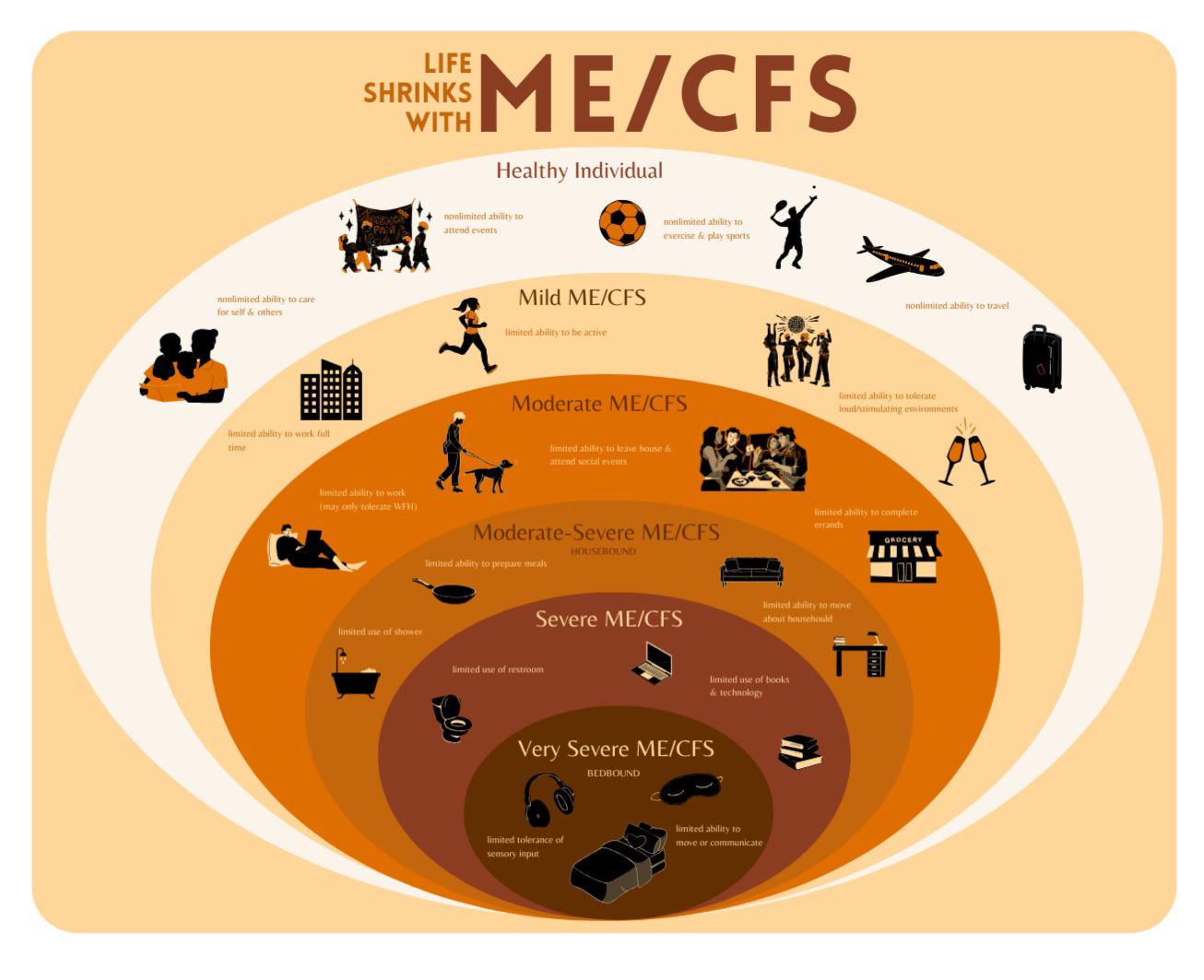
One classification scale is divided into mild – moderate – severe – very severe – (extremely or profoundly severe) categories, depending on what activities a person is still capable of.
The extremely severe are usually unable to speak, eat, or tolerate light. Just moving in bed can send them into PEM.
Now, take a moment to think about what a person with “mild” myalgic encephalomyelitis might be able to do.
Then consider that the international consensus criteria for the diagnosis of myalgic encephalomyelitis specify that, in order to be diagnosed, one has to have a 50% reduction in functional capacity.
A healthy person sleeps about 8 hours per day. That means they have 16 usable hours per day. Working for 8 to 9 of these leaves them with 7 to 8 hours for commuting, chores, meals, personal hygiene, sport, taking care of the kids, hobbies, etc.
Now cut that in half. Imagine you only have 8 usable hours per day. That means a full-time job working from home uses up all these hours. The rest of your day is spent recovering from work. You cannot make yourself a meal. You cannot quickly go grocery shopping after work. You cannot shower after work. You cannot participate in any recreational activities. You have to do all these things on the weekend, again with only 8 usable hours.
So, you could cut back to part-time and only work 4 hours per day. That will probably not be enough to make a living, but at least you’ll be able to perform personal hygiene, cook yourself a meal, maybe even meet a friend, or play with the kids occasionally. That is, unless there was an unexpected, short deadline at work the other day, so now you are in PEM and all you can do is lie in a dark room and hope it will pass soon.
This is “mild” myalgic encephalomyelitis. There is nothing “mild” about it. People with “mild” myalgic encephalomyelitis are severely disabled and often have constant symptoms.
This is why we need a better way to characterize the severity of myalgic encephalomyelitis.
This excellent graphic shows in a bit more detail what the different severities look like. (Image taken from: https://www.reddit.com/r/cfs/comments/1j0j5zt/new_mecfs_graphic/ )